We know that π is related to circles. But how exactly?
Let’s start with a simple example.
Consider a circle with diameter 1.
The formula for the circumference of a circle is
Since the diameter is 1, the circumference must be π.
If we could cut the circle and straighten the circumference into a line, that line would have length π, or about 3.14.
The circumference of a circle "straightened out" to a line
Growing Circles
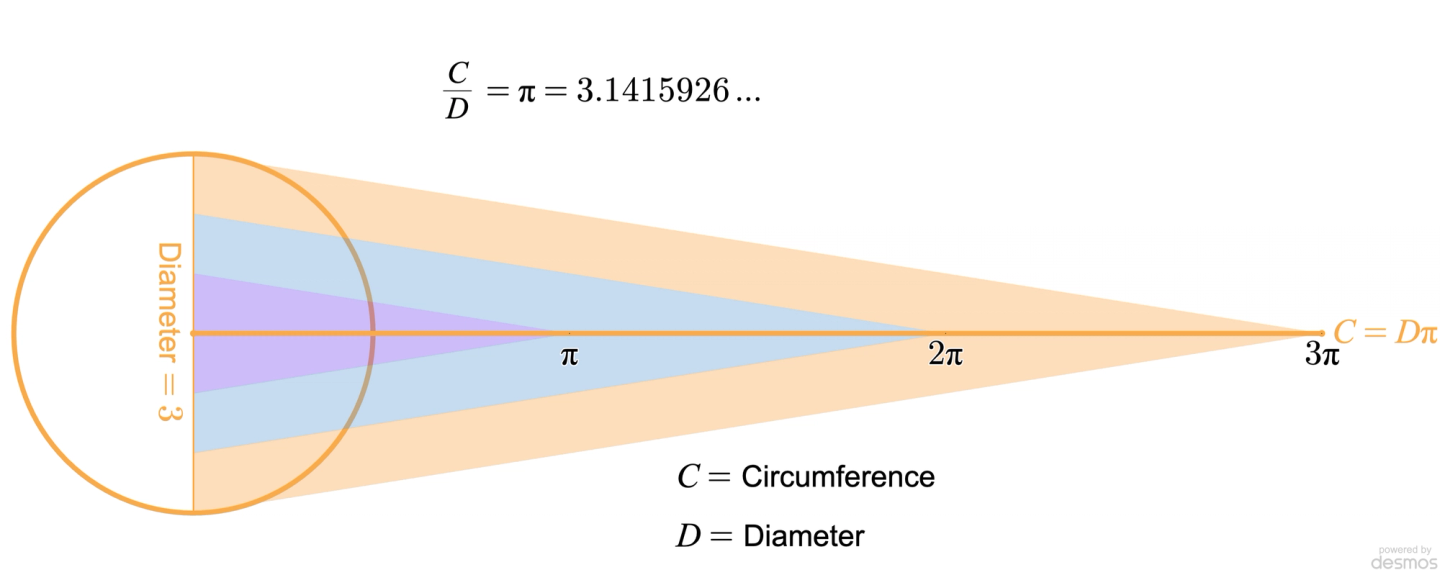
Now let’s consider circles with diameters 1, 2, and 3.
If we straighten the circumference of each circle into a line, something interesting appears.
- The circle with diameter 2 has a circumference that looks twice as long as the circle with diameter 1.
- The circle with diameter 3 has a circumference that looks three times as long.
This suggests a key concept:
The circumference of a circle grows proportionally with the diameter.
Circles with diameters 1, 2, and 3 create similar triangles
A Linear Relationship
We can make this idea clearer with a graph.
The circumference of a circle (output) based on the diameter of a circle (input)
Notice in the graph above:
- The input is the diameter of a circle.
- The output is the circumference.
When we plot this relationship, the points fall on a straight line.
Why?
Because the formula is
If we write this using the familiar and notation from algebra, we get
This is the equation of a line.
Recall from algebra that the equation of a line is
where:
- is the slope
- is the intercept
For our circle relationship:
- The intercept is 0 (when the diameter is 0, the circumference is also 0).
- The slope is π.
So π is not just a number attached to circles.
It is the slope of the relationship between a circle’s diameter and its circumference.
A Geometric View
If we return to our circles with diameters 1, 2, and 3, we can visualize this relationship another way.
Similar triangles created from a circle
When we straighten the circumference into a line and connect it to the diameter, we form a triangle.
Each of these triangles has the same shape but a different size. In geometry, this means the triangles are similar.
Similar triangles always share the same ratio between their sides.
In this case, that common ratio is the height increases by π as the diameter increases by 1.
What π Really Tells Us
This reveals something beautiful.
No matter how large or small a circle becomes, its shape never changes. Every circle is similar to every other circle.
Because of this, the ratio between the circumference and the diameter is always the same.
That constant ratio is π.
And that means π is not just a number associated with circles.
It is the constant rate of growth between a circle’s diameter and its circumference.
A Different Way to See π
Instead of thinking of π as a mysterious decimal like
we can see it as something simpler and more geometric:
π is the slope of circles.
It tells us how quickly the distance around a circle grows as its diameter grows.
Why This Matters
Mathematics often reveals constants through proportional relationships.
For circles, that constant is π.
Every circle, no matter its size, follows the same rule:
And that simple relationship is why π appears frequently in mathematics, science, and the natural world.