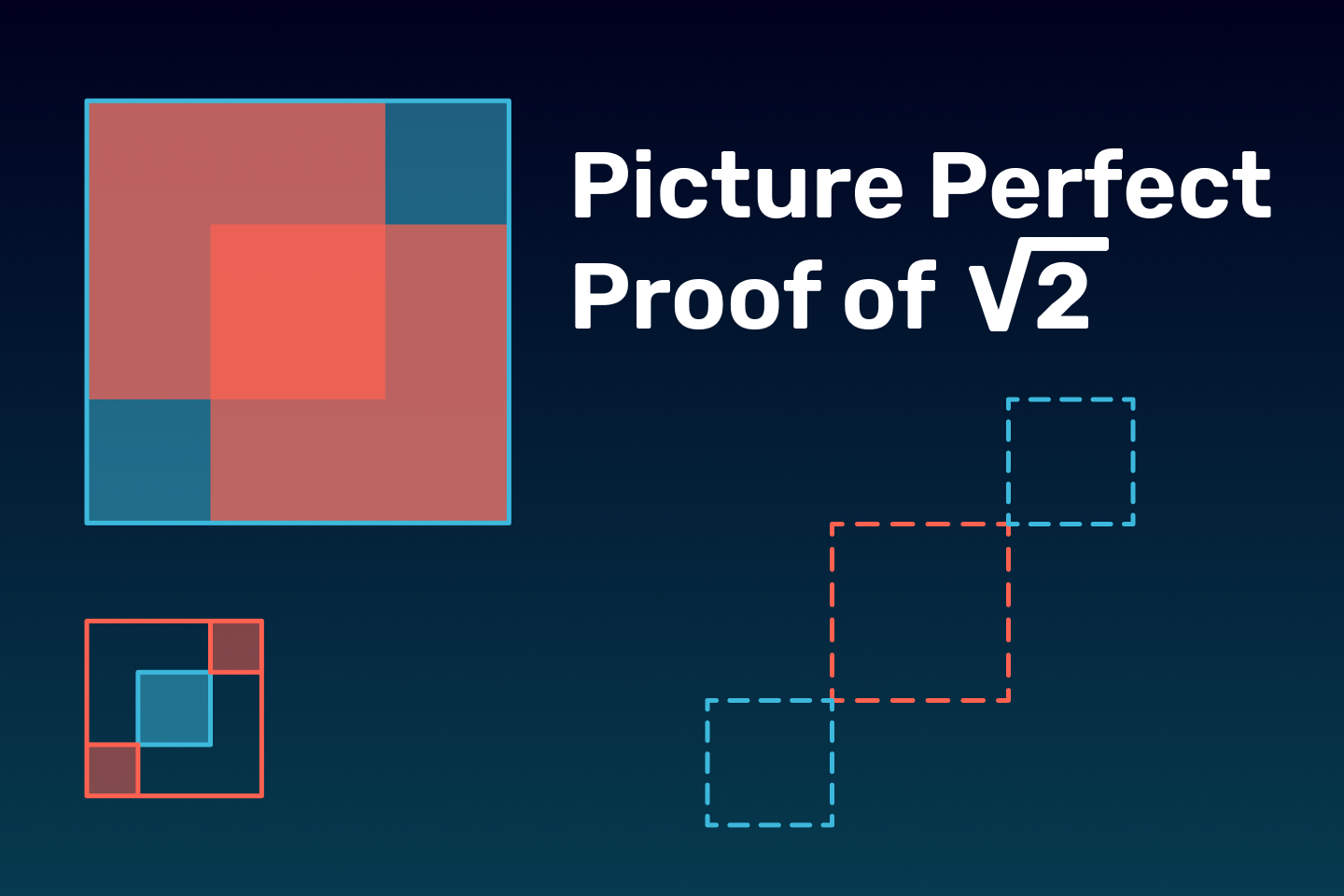
We can view proofs from different perspectives as well as people
“Every being cries out silently to be read differently.”
Simone Weil, quoted in Francis Su, Mathematics for Human Flourishing
The goal for this proof is that in one picture, you will be convinced beyond a shadow of a doubt that cannot be expressed with a finite number of digits.
Two quick lenses before the proof
1) A small paradox. Our goal is to prove is irrational. But if a number is irrational, we can’t express it as a ratio of whole numbers. So how do we prove something we can’t “write down” as a neat fraction? Rather than chasing digits, we’ll change the picture.
2) Change dimensions. We do know a defining truth about : it’s the number whose square is 2. That’s a 2-dimensional clue. So rather than thinking about one-dimensional lengths, we’ll think in areas—with squares. Let be the side of a big square and the side of each small square. If were a ratio of whole numbers , then , i.e., . That translates cleanly into a question about areas of squares.
A quick warm-up (why “double-covered = not-covered” is natural)
Take two identical squares and place them side-by-side to make a rectangle. Same pieces, same total area.
Area for two smaller squares equals area for rectangle
Now slide the left square right, say by 1 unit inside that rectangle:
- On the left edge you create a not-covered strip that’s .
- In the middle you create a covered twice strip that’s also .
Not Covered Area = Covered Twice Area
You can also think of it as not counted area and double counted area. Either way, because the total area hasn’t changed, the covered twice area equals the not-covered area. This simple “slide principle” is the only engine we’ll need when we move to squares.
When a Square Speaks
We’ll show—by picture alone—that no matter what whole numbers you choose, two identical small squares can never have exactly the same total area as one larger square. That kind of equality is easy if the larger shape is a rectangle (as in the warm-up). It becomes truly interesting—and decisive—when we require the larger shape to be a square. From there, it will be almost immediate that can’t be a ratio of whole numbers.
Changing the into a square of equal area
We’ll do this in two parts:
- Geometric descent: assume such an equality exists; the picture manufactures a smaller equality of the same kind—then smaller again, and so on. That’s impossible in the positive whole numbers.
- Equivalence to : why “two equal smalls = one big” would force the side-length ratio to be —so the impossibility above is exactly “ is irrational.”
Part 1 — The geometric descent (the jigsaw that shrinks)
Imagine—just for contradiction—that you’ve found whole numbers where the areas match:
- two identical small squares of side 5 (area 25 each, total 50), and
- one big square whose side is some whole number with area .
Square with side length and two smaller squares with equal area
(We know there’s no such , but the point is to assume there is and let the picture do the work.)
Place the two squares inside the big square—one tucked into the top-left corner, the other into the bottom-right—so they overlap in the center.
Look at what the placement creates:
- Two uncovered corner squares (top-right and bottom-left).
- One central overlap square (the region covered twice by the smalls).
Counted twice area = Not counted
By the slide principle, double-counted area = not-counted area. In this square setting, those regions are themselves squares (by symmetry and alignment), so we get:
(central overlap area, counted once) = (sum of the two uncovered corner areas).
New setup matches original setup, only smaller
Even better, their side lengths are integer differences you can read off the picture:
- Each uncovered corner square has side (big side minus small side).
- The central overlap square has side (two small sides minus the big).
So from our assumed example we’ve produced a smaller example of the same kind:
two identical small squares of side equal in area to one big square of side .
New setup with integer lengths
Why “smaller”? Since must lie strictly between and (otherwise the two ’s wouldn’t fit and overlap as arranged), both and are positive whole numbers smaller than and , respectively.
Thus the same “two smalls = one big” pattern appears at a smaller scale—again with whole-number sides. Repeat the placement with these new squares and you get an even smaller trio; repeat, repeat…
Repeat the setup of 2 small squares = 1 large square (but smaller)
But the positive whole numbers cannot descend forever. You can’t keep producing strictly smaller positive whole numbers without end. That contradiction means our very first assumption was wrong:
No two identical whole-number squares can have the same total area as one larger whole-number square.
(And nothing was special about choosing side ; the same descent traps any supposed whole-number example.)
Repeat once more
Extract the double counted and not counted squares
Repeat
Part 2 — Why that is exactly “ is irrational”
If such an equality of areas ever existed with whole-number side lengths—two smalls (side ) and one big (side )—it would say:
Divide by and take square roots:
But would then be a ratio of whole numbers—i.e., rational—equal to . That contradicts the geometric descent we just proved. Therefore:
cannot be written as a ratio of whole numbers. is irrational.
Pause and notice (let the picture do its work)
Before we move on, let's sit with the picture so the entire story is visible: two identical squares tucked into one larger square, overlapping in the middle and leaving two uncovered corners. You now know that with whole-number side lengths, this arrangement can never make “two small areas = one big area.” The jigsaw forces a smaller copy of the same setup, and whole numbers can’t descend forever.
Final view
That single visual fact already implies the headline: if equality of areas ever held, we’d have , so would be a ratio of integers—rational. Our picture shows that can’t happen. So is irrational. Can you truly see why MUST be irrational from this picture alone?
A glimpse of the near-hits (full story in the Epilogue)
Near hits of
Consider this chain of fractions: Each fraction approaches the true value of , alternating above/below. Square them and you get near-misses for 2: high, low, high… ever tighter. For one snapshot: . That “almost-equal” rhythm is exactly what our square picture predicts: close forever, never equal.
Approximating
If you’d like the generator for these best approximations (and an animation), the Epilogue walks it step-by-step.