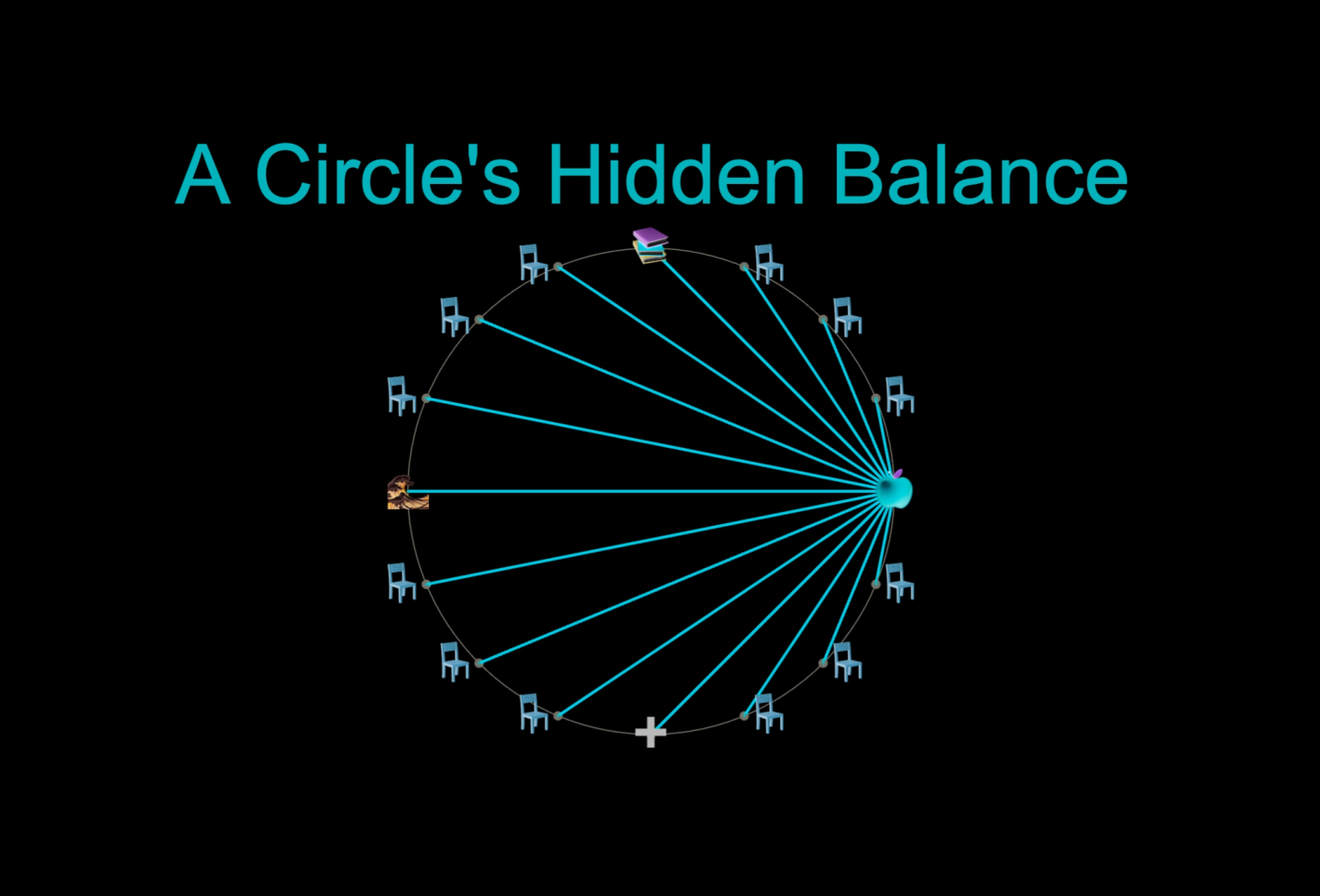
How a circle’s hidden beauty awakens us to what has always been — a playful journey with friends into symmetry, imagination, and infinity.
Series Introduction
What if a group of actuarial friends pulled up chairs at a perfectly round dinner table? Not for business, but for a puzzle. Each time we measure the distances around this circle and multiply them together, strange patterns appear. At first the numbers look messy, full of square roots. But step back, and they collapse into something beautifully simple.
As actuaries, we’re used to practical formulas — tools designed by humans to manage risk and profit. But here, the formulas weren’t invented; they were discovered. They live in the circle itself, waiting for us to notice.
And as we’ll see, the story isn’t only about large patterns or infinite products. Sometimes the smallest chords — the ones easiest to overlook — turn out to carry the biggest surprises.
In this five-part series, we’ll follow Ivey, Hannah, and the rest of our group as we uncover this harmony. It’s a story of symmetry — not just at the center of the circle, but in the chords, the seating, and the hidden connections between perspectives.
🍷 Part 1: Ivey’s Distances
Imagine sitting at a perfectly round dinner table — our unit circle. Around it, friends take their seats, evenly spaced. This symmetry creates regular shapes: with 2 guests you get a line, with 3 a triangle, with 4 a square, and so on.
But instead of looking from the center of the circle (the obvious symmetry), let’s sit with Ivey 🍎, a former math teacher.
🪑 Case n = 2 It’s just Ivey 🍎 and David 🌊, opposite each other. The distance between them is the diameter of the circle: 2. Multiply it (since there’s only one distance), and the product is 2. ✨ The product equals the number of people.
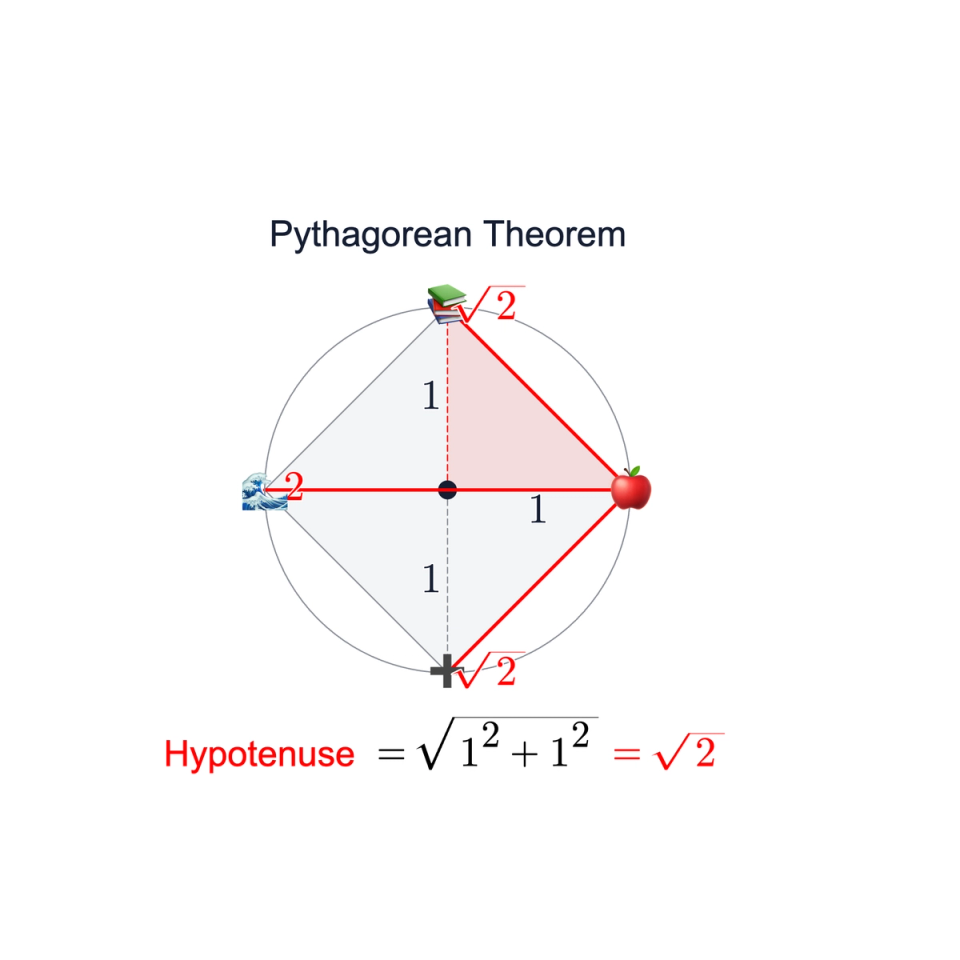
🪑 Case n = 4 Now Brian 📚 and I ✚ join the table, making a square. Ivey’s distances are:
- Across to David 🌊: 2
- To Brian 📚:
- To me ✚:
Multiply them: . ✨ Once again, the product equals the number of people.
🪑 Case n = 8 We double the seats. The original four remain, and four new friends slip in halfway between them. Ivey’s new distances come in two flavors:
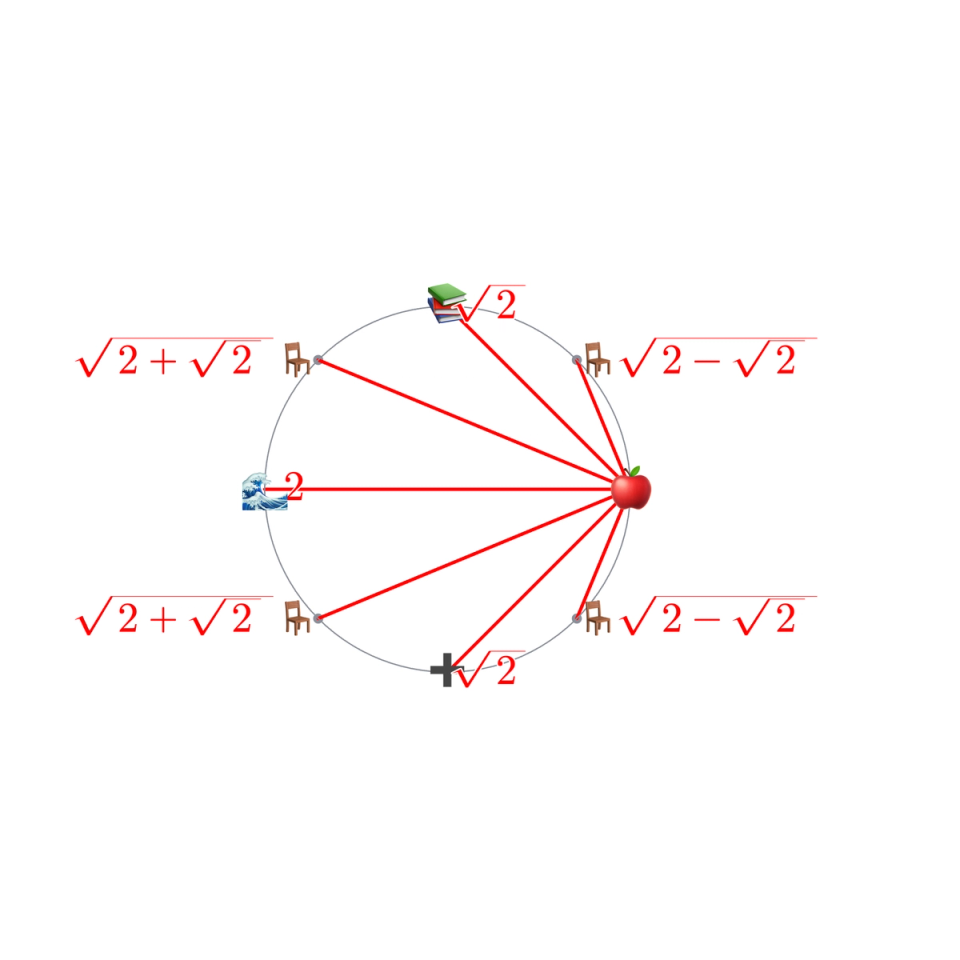
Each type appears twice. Pair one of each on the top:
The bottom pair gives another
Multiply both sides together: .
Combine with the old product of (which was 4): .
✨ The product equals the number of people yet again.
🌟 The Pattern For 2, 4, 8 — and in fact for any n — the product of Ivey’s distances to the others equals n:
At first, the distances look messy, filled with square roots. But multiplied together, they collapse into something beautifully simple. Symmetry is not just at the center of the circle — it’s hidden in the chords connecting one person to all the others. It’s the kind of clean formula actuaries dream of — a rule that holds not just for one case, but for all cases.
✨ The pattern feels magical — messy numbers folding into whole ones. But what happens if Hannah 🌸 joins the table, not evenly spaced, but halfway between two seats? Will the magic break … or reveal something deeper? That’s where the story picks up in Part 2.
Go to Part 2
🌈For Fun
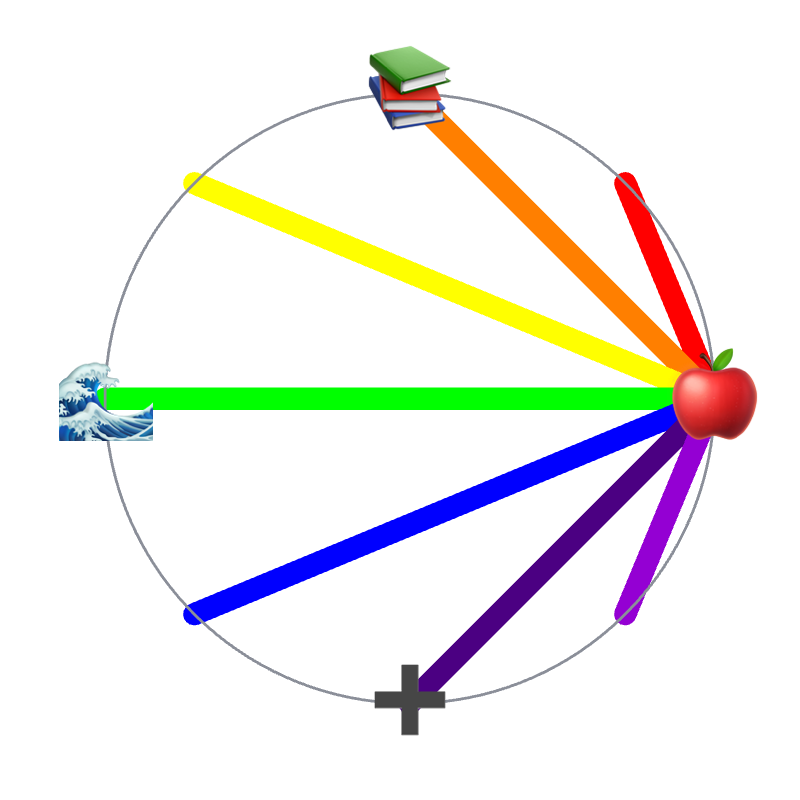
📐 Math Appendix — Details Behind the Circle’s Hidden Balance
This appendix gathers the math details. If you prefer to enjoy the story as a tale of symmetry and imagination, feel free to skip this section. But if you want to peek “under the hood,” here’s how the numbers work.
Ivey’s Perspective (Product = n)
Setup: The Unit Circle
- Work on the unit circle (radius = 1). Because the radius is 1, chord lengths depend only on the angle—no scaling factors to worry about.
- Place Ivey at (1, 0) — the rightmost point.
- Seat n people evenly around the circle at angles:
So guest k has coordinates
We’ll use degrees throughout; feel free to translate to radians if you prefer.
Distance Formula
The distance from Ivey to a guest at angle
Simplify:
Using the half-angle identity from trigonometry
we get:
This will be our main tool. In other words, the distance from the Ivey to any other point on the unit circle depends only on the angle between them. We will use degrees but feel free to convert to radians.
Case
Seats: (Ivey) and (David).
- Distance Ivey–David:
Product = 2. ✔️ Matches the number of seats.
Case
Seats:
Distances from Ivey:
- To
- To
Product:
✔️ Matches the number of seats.
Case
Seats every The new ones (relative to ) are at
Distances:
Pair them:
Left side = , right side = . Total product of new seats
Multiply by the old product (which was 4):
✔️ Matches the number of seats.
✅ In general:
Go to Part 2


