🍷 Part 2 — Hannah’s Perspective
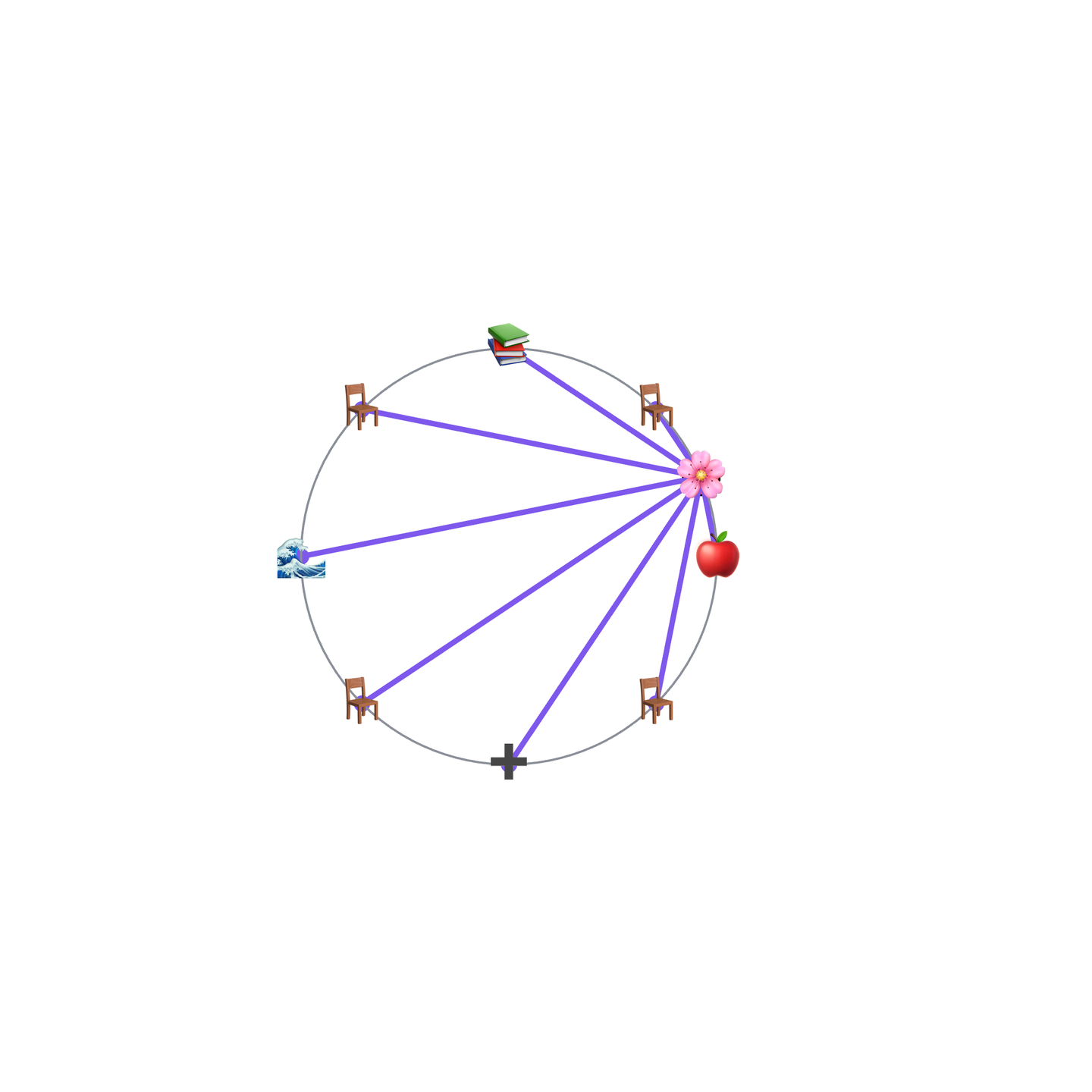
Now Hannah 🌸 takes a chair — but she doesn’t sit evenly around the circle. Instead, she chooses the halfway point between Ivey 🍎 and her nearest neighbor. Her placement looks “off,” as if the symmetry is broken.
Yet when she measures her distances to everyone else and multiplies them, something stunning happens: no matter how many people are at the table, the product always equals 2.
🪑 Case n = 2 Two seats: Ivey 🍎 and David 🌊, opposite each other. Hannah squeezes in halfway.
- To Ivey:
- To David:
Multiply → .
🪑 Case n = 3 Now the table is a triangle: Ivey 🍎 at and two guests equally spaced.
Hannah sits halfway between Ivey and a guest🪑. Her distances are:
- To Ivey 🍎: 1
- To closest guest🪑: 1
- To furthest guest🪑 directly across the table: 2
Multiply → 1 × 1 × 2 = 2. ✨ Still constant.
🪑 Case n = 4
With four seats, the numbers get messier, and , but the symmetry works itself out. Multiply the Brian 📚 and David 🌊 pair to get , mirror with Dave ✚ and Ivey 🍎 for another , and together you’re back at 2.
✨ The Pattern
Whether there are 2 seats, 3 seats, 4 seats, or more, Hannah’s product always equals 2.
From Ivey’s chair, symmetry was obvious. From Hannah’s, symmetry looked broken — yet her product stayed constant. Two perspectives, two stories…
But then Hannah noticed something unexpected. Her “constant 2” wasn’t just its own curiosity — it was secretly powering Ivey’s pattern every time the table doubled the number of guests.
And that’s the twist we’ll uncover in Part 3.
Go to Part 3


