🍷 Part 5 — The Proof Behind the Pattern
In Part 4, we built intuition with the parent–child idea: every chord in Ivey’s circle splits into two children when the table doubles, and those children multiply back into the parent. That intuition explained Hannah’s constant factor of 2.
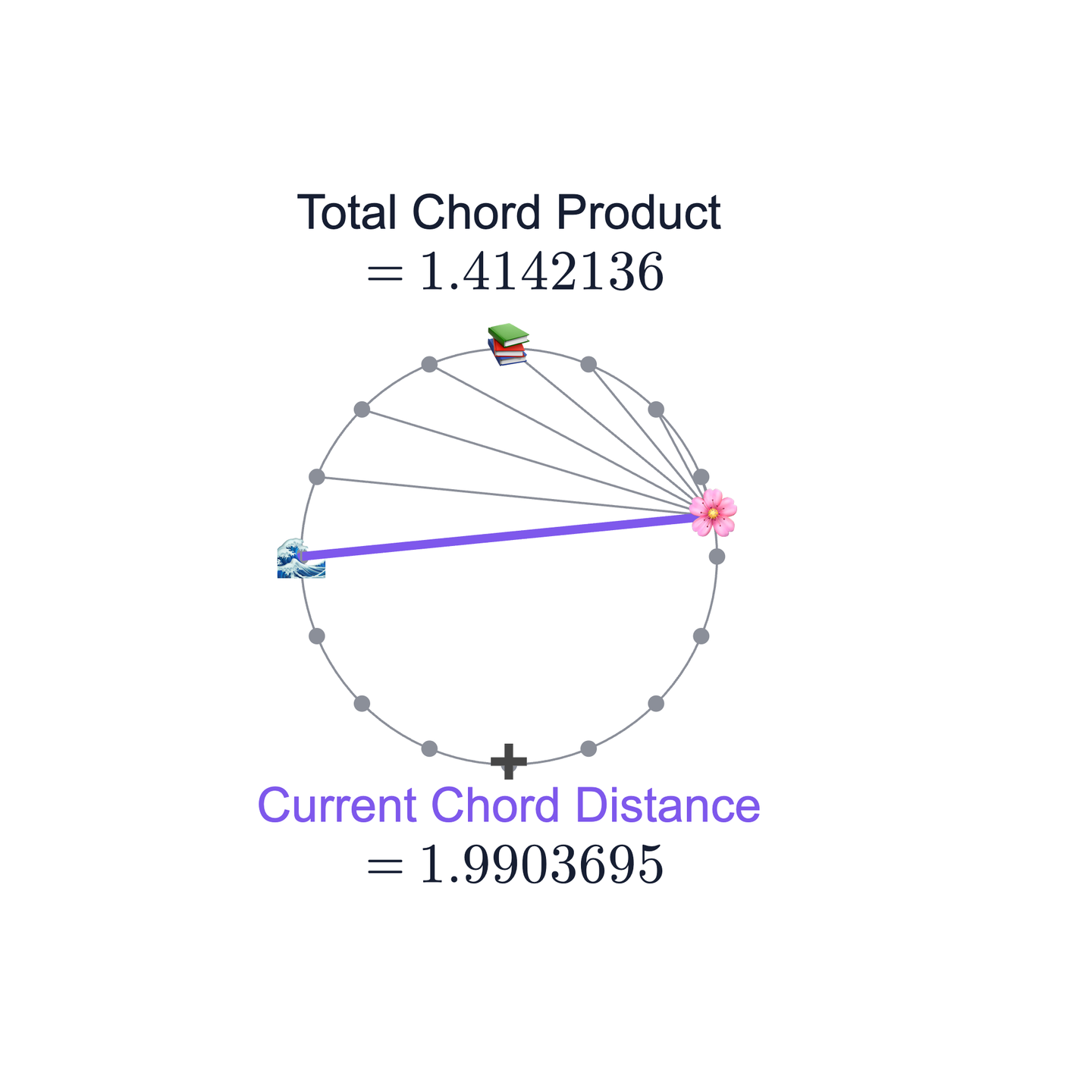
Before we uncover the reason for the intuition, let's remind ourselves how remarkable this is. Here are the product results for our case from both Ivey's perspective and Hannah's.
You can see for both cases how the total product increases significantly and is rounded to several decimal places. Certainly messy results on the journey around the circle. But, in the end, when the final distance is multiplied, both finish at our predictable integer 16 or 2.
But where does this come from? Why should chords split so neatly? To see it, we need just one key fact about circles.
The chord–sine connection
If a seat sits at angle θ from Ivey’s position at (1,0) on the unit circle, the straight-line distance (the chord) between them isn’t random or messy. It always comes from a simple formula:
That’s the secret. Every chord length is really a sine in disguise. Once you see this, the rest of the story falls into place. Here's a visual as to how beautiful and simple this works.
Let's pause a moment and sort of celebrate how amazing this is. We can literally measure the distance between any two points on a circle just by knowing this angle, which we call .
The parent–child identity
Now suppose we take a chord with angle . What happens when we invite the next generation and double the seats at the table, slicing that angle in half? The parent chord splits into two children:
Here’s the magical part:
In words: the parent chord length equals the product of its two children.
That’s the exact mechanism behind the doubling process. Every time the table doubles, every parent chord gives birth to two children whose product collapses back into the parent.
Examples
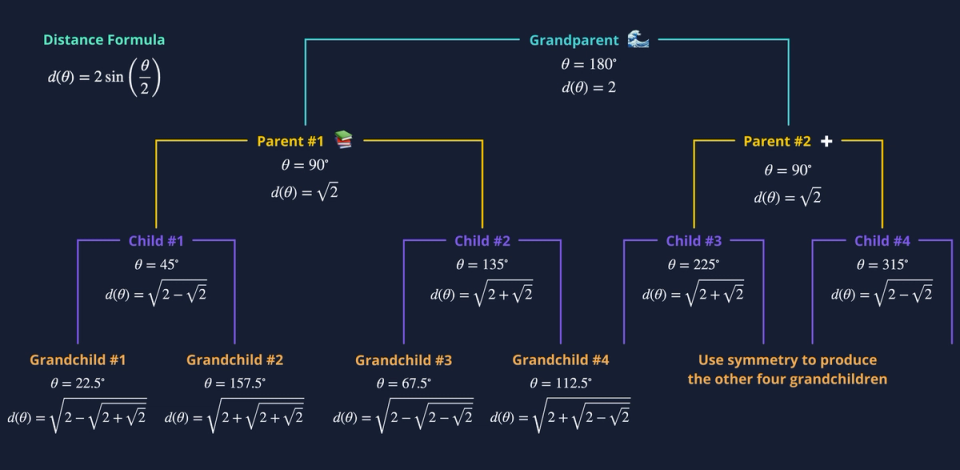
Take n = 2 → 4. The 180° chord has length 2. When the circle doubles, it splits into two children at 90° and 270°, both with length . Multiply them: The children give back the parent.
Take n = 4 → 8. The 90° chord has length . When the circle doubles, it splits into two children at 45° with length and 135° with length . Multiply them: . The children give back the parent.
With n = 8 → 16, it happens again, though with messier radicals. The 45° chord splits into two children, each involving nested square roots. Multiply them together, and you recover the parent chord exactly.
The infinite family tree
This process repeats forever:
- Parents split into children.
- The children multiply back to their parents.
- Those children become parents in the next doubling.
The family tree grows without end. And yet, at every stage, the product of all new chords across the circle is exactly Hannah’s constant 2.
The beauty revealed
At first, the radicals looked hopelessly messy. But they aren’t chaos at all. They’re just sine and cosine playing complementary roles, making sure every parent–child pair collapses into harmony.
That’s why Hannah’s perspective is so powerful: her constant “2” isn’t a coincidence. It’s the hidden law that keeps Ivey’s product doubling step after step, forever.
✨ This is the circle’s hidden balance in its purest form:
- Intuition from the family-tree story.
- Proof from the chord identity.
- A pattern that stretches into infinity.
✨ We’ve now reached the end of the math journey — from Ivey’s growing products, to Hannah’s constant 2, to the parent–child structure that explains it all. But there’s still one more step. In the Epilogue, we step back from the equations and reflect on what this circle story means for us — as actuaries, as friends, and as people living with life’s own messy radicals. I hope you’ll join me there.
Go to Epilogue
📐 Math Appendix — Part 5 (The Proof Behind the Pattern)
A. General chord identity
For Ivey at on the unit circle, the distance to a point at angle is:
Now consider halving that angle.
- Child 1:
- Child 2:
Multiplying gives:
Simplify:
But
✅ Identity confirmed:
This is the parent–child relationship that powers the doubling pattern.
B. Worked examples
Example 1: , short parent
- Parent:
- Children:
- Product:
✅ Matches the parent.
Example 2: long parent
- Parent:
- Children:
- Product:
✅ Matches the parent.
C. Why it matters
- Each parent chord splits into two children.
- The children’s product always equals the parent.
- By symmetry, the process repeats on both halves of the circle.
- So when the number of points doubles, the product of all the new chords equals 2 — Hannah’s constant factor.
This algebra confirms the intuition we built in Part 4. The “messy radicals” aren’t random: they’re just sine and cosine working together, ensuring the parent–child pattern holds forever.
Go to Epilogue


