🍷 Part 4 — Intuition of Doubling
In our circle story so far, Ivey’s product has grown step by step:
- n=2 → product = 2
- n=4 → product = 4
- n=8 → product = 8
Meanwhile, Hannah’s product has stayed constant at 2, no matter how many people sat down. In Part 3, we saw that Hannah’s “2” is the very factor that drives Ivey’s doubling.
The family-tree idea
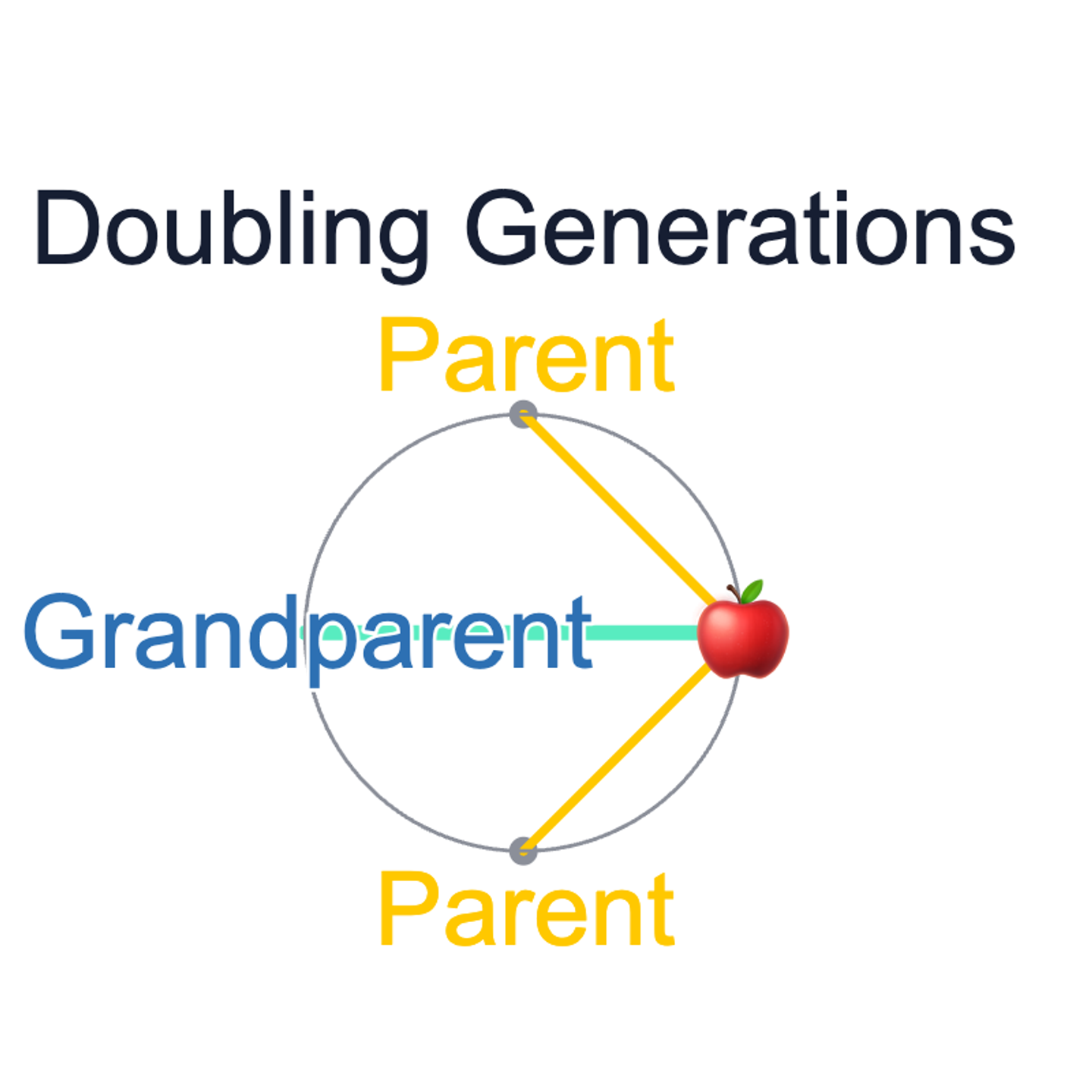
Think of each chord distance from Ivey’s seat as a parent. When the circle doubles, each parent “splits” into two children:
- one child is shorter than the parent,
- the other is longer.
3 generations: 1 grandparent, 2 parents, 4 children
On their own, the children look unrelated to the parent. But multiply them together, and something magical happens:
✨ The product of the children equals the parent.
This pattern repeats each time we double the seats, like a family tree unfolding across the circle.
Example 1: n = 2 → 4
With just two people, Ivey’s product is 2. When we double to four, the new distances are and . Think of them as the two children of the original chord (length 2). Multiply them:
The children reproduce the parent exactly.
1 Grandparent to 2 parents
1 parent to 2 children
Example 2: n = 4 → 8
Now start with n=4. Ivey’s product is 4. Doubling to 8 adds four new chords. On one side, the parent splits into two children:
- a smaller distance
- a larger distance
On their own, they look messy. But multiply them:
Exactly the parent again.
Example 3: n = 8 → 16
The pattern doesn’t stop. Each of those messy children now becomes a parent in the next round. When the table doubles again, each splits into two new distances (black dotted lines) — one shorter, one longer — whose product collapses back to the parent.
So the family tree keeps branching:
- Parents split into children.
- Children reproduce the parent when multiplied.
- Those children become parents in the next doubling.
And at every stage, the overall effect is Hannah’s constant 2 showing up again.
Why this matters
From Ivey’s seat, the product keeps growing: 2, 4, 8, 16 …
From Hannah’s seat, the product remains constant: always 2.
The reason they line up so perfectly is this parent–child rule, hidden in the structure of the circle.
What looks like mess (all those nested square roots) is really just the family pattern repeating forever. And that repetition is what makes Hannah’s 2 the hidden motor that powers Ivey’s doubling.
✨ We’ve now seen the intuition of why Hannah’s constant 2 appears again and again: each doubling is really just chords splitting into children whose products return to their parent. But intuition isn’t proof. In Part 5, we’ll dig into the trigonometry and see exactly why this multiplication rule works.
Go to Part 5
📐 Math Appendix — Part 4 (Intuition of Doubling)
Chord formula (recap):
For an angle on the unit circle, the chord length from is
Parent–child identity:
Every chord at angle splits into two “children” when the table doubles:
Example (splitting a parent):
Take the chord at . Its length is
Doubling the table creates two children:
Multiply them:
So the children reproduce the parent.
Takeaway:
Each doubling step splits chords into pairs whose product equals their parent chord. This is the algebraic backbone of the intuitive “parent–child” story.
Symmetry halves the problem
Notice as we build the family tree on the top half of the circle with angles less than , the bottom half of a circle is a mirror image of the top half of the circle.
Go to Part 5


